
How Outsourcing Drywall Estimating Services Helps Contractors Bid More, Earn More, and Grow Faster
You just got off the phone with a general contractor. There's a 40,000-square-foot commercial office buildout going to bid in four days. It's exactly the kind of work you've been chasing. But your estimator is buried in two residential projects, your project manager is juggling punch lists, and you don't have the bandwidth to put together a tight drywall estimating services package in time. So you pass. Again. That's not a capacity problem. That's a systems problem and it's costing you jobs. Contractors across the country are discovering that outsourcing drywall takeoff services in the USA isn't a shortcut. It's a smarter way to run a bidding operation. At Remarkable Estimating Services, we're a California-based estimating firm helping contractors in all 50 states win more bids by delivering fast, accurate, location-specific drywall estimates without adding headcount to your payroll. Here's what that actually looks like in practice, and why it changes everything about how you grow your business.
Related service: drywall estimating and takeoff services.
Why Drywall Estimating Is Harder Than Most Contractors Expect
Drywall sounds simple until you're standing in front of a set of plans with a complex ceiling grid, multiple fire-rated assemblies, ACT transitions, and 14 different wall types across four floors. Suddenly "just count the square footage" doesn't cut it. Accurate drywall takeoff services require:
- Identifying every CSI Division 09 partition type by fire rating, STC rating, and height
- Calculating board quantities by thickness (½", ⅝", Type X, moisture-resistant, abuse-resistant)
- Breaking out metal framing by gauge, stud size, and spacing (25ga vs. 20ga vs. 16ga)
- Accounting for specialty assemblies shaft walls, area separation walls, corridor partitions
- Separating labor and material by scope: framing, boarding, taping, finishing, and Level 5 work
- Applying accurate local waste factors (typically 8–15% for drywall board depending on cut patterns)
Miss any of these layers and you're either leaving money on the table or buying your way onto the job. A drywall estimator in California working on a high-rise in Los Angeles faces entirely different material and labor pricing than a contractor bidding a medical clinic in Houston or a school renovation in Chicago. Generic pricing doesn't win bids. Localized, defensible numbers do.
What Outsourced Drywall Estimating Services Actually Deliver
When you send your plans to Remarkable Estimating Services, here's what comes back not a ballpark, not a guess, but a fully itemized, review-ready estimate:
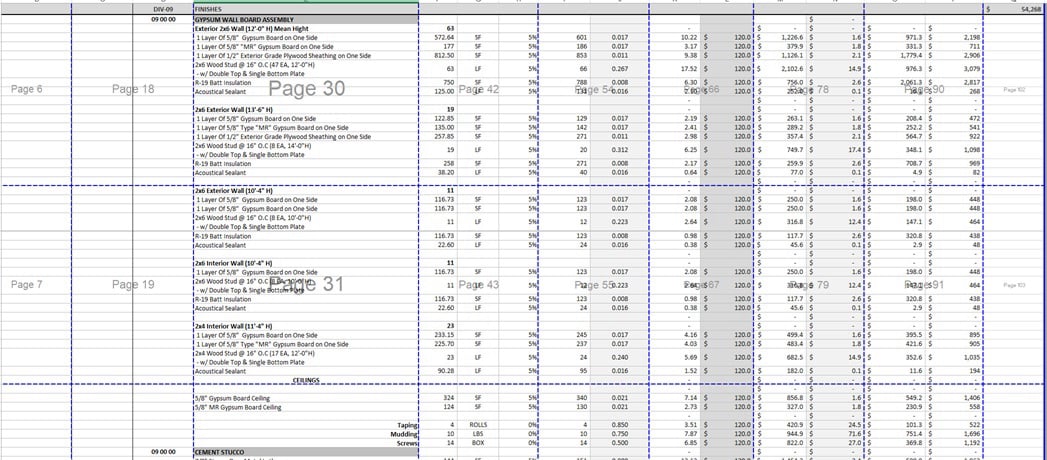
- Complete Material Takeoffs: Every board, every stud, every fastener, every pound of compound is counted and listed. Our takeoffs are organized by CSI MasterFormat structure (Division 09 – Finishes), which means your numbers plug cleanly into your bid templates, and GCs who review them can follow the logic immediately. We use PlanSwift and Bluebeam Revu for digital plan markup so every measurement is visible, color-coded, and auditable. Every area is labeled. Every assumption is noted. If a GC asks where your numbers came from, you can show them exactly.
- Separate Labor and Material Pricing by Location: This is where most generic estimating falls apart. A drywall finisher in San Francisco costs more than one in Memphis. Lumber and board pricing in the Pacific Northwest differs from pricing in the Southeast. We research and apply current RSMeans data and local supplier pricing for wherever your project is located so your labor and material line items reflect the actual market, not a national average that fits nobody perfectly. Whether you're bidding a project in California, Texas, Florida, New York, or anywhere in between, your estimate reflects real, current costs for that ZIP code.
- Residential, Commercial, and Industrial Scopes: Every scope is delivered with a separate residential, commercial, or industrial breakdown so your PMs, supers, and accounting team can pull the numbers they need without decoding a combined spreadsheet. We cover all three project sectors, and we keep them clearly organized.
Residential drywall scopes typically include
- Single-family and multifamily drywall scopes
- Board and texture specifications by room type
- Moisture-resistant assemblies for baths and utility rooms
- Fire-rated assemblies at garages and between units
- Level 4 and Level 5 finish specifications
Commercial drywall scopes typically include
- Full tenant improvement and core-and-shell scopes
- Ceiling grid and suspension system takeoffs
- Fire-rated corridor and shaft wall assemblies
- ACT and drywall ceiling transitions
- Specialty rooms: server rooms, clean rooms, medical suites
Industrial drywall scopes typically include
- Warehouse and distribution center office buildouts
- High-humidity and chemical-resistant assembly specifications
- Impact-resistant and abuse-resistant board applications
- Blast-resistant and demising partition scopes
- Large-footprint projects with repetitive bay structures
The Real Cost of Running In-House Drywall Estimating
An experienced in-house drywall estimator is a significant fixed cost. Beyond salary, add benefits, takeoff software licenses, cost-data subscriptions and overhead allocation, and the all-in cost is considerably higher than the salary alone, before they produce a single takeoff. And here's the part that never shows up on a spreadsheet: what happens when they're backed up? You miss bids. You rush estimates. You submit numbers with errors that either lose you the job or win you a money-losing project, both of which are expensive outcomes. For contractors with variable bid volume, outsourcing can offer:
- Lower cost than carrying full-time estimating capacity through slow periods
- Standard turnaround of 48–72 hours on typical drywall scopes
- Pricing quoted per project, as a flat fee or hourly rate, instead of paying for idle capacity
- Capacity that scales with bid volume without adding headcount
Benefits of Outsourcing Drywall Estimating
- You Chase More Opportunities: When estimating isn't your bottleneck, you stop pre-screening opportunities by how much bandwidth you have. That 40,000-square-foot commercial job? You bid it. The fast-track medical tenant improvement that needs numbers in 48 hours? You're in. Contractors who outsource their drywall estimating can bid more projects without adding staff. More bids with consistent accuracy means more wins.
- Your Numbers Get Tighter: GCs notice when your bid packages are clean and detailed. When your estimate shows board quantities by type, framing by gauge, labor broken out by phase, and a clear list of inclusions and exclusions, you build credibility. You're not just throwing a number you're showing you understand the job. Tight, defensible bids win in competitive markets. Vague lump sums get cut.
- Your Team Focuses on Field Execution: When your project managers aren't moonlighting as estimators and your superintendents aren't doing material counts off plan prints at 10 PM, they're better at their actual jobs. That's where your margin really lives in efficient field operations, not in the estimating room.
Common Drywall Estimating Mistakes
- Using square-foot pricing instead of detailed takeoffs: Fine for budget conversations, disastrous for competitive bids
- Ignoring fire rating and STC requirements: Missing a UL-listed assembly spec can mean pricing the wrong board thickness across thousands of square feet
- Applying flat waste factors: Waste on a simple rectangular room differs significantly from waste on a curved feature wall or coffered ceiling
- Not separating labor by finish level: Level 3, Level 4, and Level 5 finishes have meaningfully different labor costs blending them destroys your margin analysis
- Using national average pricing for local bids: RSMeans city cost indexes exist for a reason: ignoring location factors can put you well off the market in either direction
- Estimating framing and boarding as a single line item: GCs reviewing your bid need to see these separated to compare scope apples-to-apples
Why California-Based Expertise Travels Well Nationwide
Remarkable Estimating Services operates out of California one of the most complex, code-intensive, and cost-variable construction markets in the country. California projects demand precision: strict fire-rating compliance, high labor costs, seismic considerations, and GCs who review every line item closely. That environment built our team's discipline. When you work in a market that doesn't tolerate sloppy estimates, you develop processes that produce accurate takeoffs regardless of project type or location. We apply that same rigor to projects in Texas, Florida, New York, Illinois, Arizona, the Pacific Northwest, the Southeast, and everywhere in between. Our estimators research local labor rates, material pricing, and code requirements for each project location so a contractor in Atlanta gets the same quality and precision as a contractor in Los Angeles.
Because we work remotely from your drawings, we can price drywall scopes for projects in any U.S. market, for example:
- Ground-up multifamily in Denver and Phoenix
- Medical office tenant improvements in Chicago and Miami
- Industrial buildouts in Houston and the Ohio River Valley
- School and institutional work across the Southeast
- High-end residential in New York and Southern California
Ready to Bid More Drywall Projects With Confidence?
Send your plans, tell us your location and scope, and we'll typically have your numbers ready within 48–72 hours, so the next opportunity that lands in your inbox isn't the one you had to pass on.
Mon – Fri, 8:00 AM – 5:00 PM Pacific · Rush turnaround available
Get Your Free Quote
Send us your plans and we'll come back with a clear scope, a realistic turnaround, and a quote for the estimate, usually within 24 hours. Want to see our work first? Ask for a free sample estimate.
Prefer to send plans directly? Email info@remarkableestimating.com or call (424) 441-4101.